



Data & Analytics Engineering | MarTech | GTM & AI Systems | Enterprise Integration | Revenue Integrity
I build enterprise data, analytics, MarTech/GTM, integration, and AI systems across B2B SaaS, enterprise ecommerce, private equity firms, and their portfolio companies.
My work includes enterprise systems architecture and repeated deployments across private equity investment platforms and their operating businesses, connecting acquired companies through governed data infrastructure, CRM and financial systems integration, stateful middleware, revenue reconciliation, and consolidated portfolio reporting.
Engineering evidence: Working Python, SQL, PostgreSQL, dbt and API implementations, executed AWS RDS recovery, native Salesforce/Snowflake/BigQuery integrations and local LLM inference. Public demonstrations use synthetic or public sample data to protect confidential client information; native executions and simulated vendor contracts are documented separately.

Interactive Engineering Evidence Lab: Explore 13 browser-based engineering investigations across 23 evidence cases, including Enterprise Integration Economics and native GA4 SQL / local dbt verification. Inspect decisions, source records, failures and integrity checks. Lab source code.
13 engineering implementations across four technical disciplines. Each project presents the problem, implementation, verification, and links to the source code and execution evidence.
SQL and dbt modeling, GA4 and conversion integrity, CDC migration, reliable source ingestion, and temporal data correctness.
 Challenge: Sales, finance, and leadership use different definitions for pipeline, bookings, invoices, cash, and ARR, so their reports often disagree. Implementation: Models these measures at their correct grain using SQL and dbt. Traces variances to source records and tests correctness and performance across substantial synthetic datasets. Verification: 15 SQL/dbt models; 87 Python and 30 dbt tests; measured synthetic-scale parity. |  First-Party Measurement Assurance Challenge: Marketing can report a signed contract as collected cash, miscount nested GA4 item rows as purchases, or miss late corrections and repeated events. Implementation: Connects consent-aware browser events with authoritative signed-contract and payment records; models GA4 event, item, session and daily grains in SQL/dbt. Adds independent source-to-model comparison on native BigQuery public-sample SELECT queries and checks incremental/replay/full-refresh correctness locally. Verification: Native read-only GoogleSQL: 1,856 events, 4,828 item rows, 14 purchases and 12 observed session keys; all five source/model rowsets matched. Local regression guard detected all 14 injected faults; 170 tests and Windows/Linux CI passed. Native dbt-BigQuery build/MERGE remains unexecuted. Explore GA4 warehouse verification | Native SQL and incremental evidence | Conversion integrity | Repository |
 Challenge: Moving customer data to a new platform can miss updates or silently change the meaning of fields even when row counts match. Implementation: Uses native PostgreSQL snapshot and WAL change capture, semantic comparisons, checkpoints, and guarded cutover and rollback decisions to find unsafe migrations. Verification: Native PostgreSQL CDC with 13 executed fault scenarios and guarded cutover. |  Challenge: Late, duplicated, incomplete or unavailable marketing and CRM source feeds can produce plausible reports with incorrect totals and unverifiable lineage. Implementation: Governs three independent HTTP source feeds through durable checkpoints, source ownership, DuckDB publication and independent reconciliation. Its containerized read-only operations console adds truthful readiness, private backup/restore, safe request telemetry and failure recovery. Verification: Actual Linux Docker Compose deployment acceptance, source outage and restart, isolated restore, restricted service identities and zero-residual teardown. Original financial and reporting evidence preserved; no public hosted service claimed. Executed deployment and recovery evidence | Independent source reconciliation | Repository |
 Challenge: Late customer events can change historical audiences. Permission withdrawal, failed handoffs and lost acknowledgments also make current activation unsafe without independent verification. Implementation: Preserves business-time and knowledge-time decisions, then governs brand-scoped activation using a PostgreSQL journal, current permission checks, exact approval, durable outbox and independent HTTP receipts. Tested worker termination, retries and destination reconciliation. Verification: PostgreSQL activation journal, current permission gates, and independent HTTP receipts. See PostgreSQL, HTTP and recovery proof | Historical decision evidence | Repository |
Customer and account intelligence, governed CRM execution, stateful integration, and evidence-based AI release controls.
 Challenge: Customer activity, CRM ownership, and lifecycle messages live in different systems. That can create duplicate outreach, bad handoffs, and unreliable attribution. Implementation: Resolves customer identity and permissions, coordinates the next action, and reconciles CRM feedback. Includes a separately executed Salesforce and Snowflake round trip. Verification: Native Salesforce/Snowflake readback plus 443 local tests and lifecycle safeguards. |  Challenge: Sales teams receive scattered buying signals and AI research but still lack a reliable way to decide who to contact and who owns the follow-up. Implementation: Combines evidence-based account prioritization, reviewed AI suggestions, CRM routing, and outcome tracking. A separate native Salesforce run verifies one guarded SDR Task. Verification: 237 tests; actual Qwen3 evaluation and separately recorded native Salesforce Task. |
 Enterprise MarTech / AI Control Plane Challenge: When CRM, marketing, and finance systems disagree, ordinary sync jobs can overwrite the right data or repeat an action after a timeout. Implementation: Implements a PostgreSQL control layer for canonical identities, field ownership, consent, durable delivery, and receipt-based recovery. Includes measured overload and isolation tests. Verification: 12,035 admitted synthetic actions independently reconciled; fault isolation, queue bounds and receiver arrival limits measured. Native AWS recovery validation is presented in the next card. |  Enterprise Agent Runtime & Evaluation Challenge: An agent can appear to work in a demo but make unsupported claims, repeat actions, or regress after a model update. Implementation: Tests actual local Qwen3 responses against evidence and action rules, then exercises shadow evaluation, canary release, promotion, and verified rollback after a controlled failure. Verification: Actual Qwen3 release: 48/48 tasks per configuration and tested rollback. |
 Native AWS Application Recovery Challenge: A successful database restore can leave the application behind business effects already committed downstream. Replaying work blindly can duplicate actions. Implementation: Used two sequential native RDS PostgreSQL point-in-time restores, independent receipt checks, fresh approval and consent enforcement, and stale-worker fencing in isolated one-off Fargate application tasks. Verification: The earlier 3-intent/5-receipt mismatch blocked execution. The later restore resumed under fresh checks and independently reconciled 6 intents and 6 effects with zero duplicates. Synthetic effects; not full production ECS/HTTPS/Multi-AZ acceptance. |
Durable order-to-cash reconciliation and controlled multi-business integration, including acquisition-specific governance.
 Enterprise Revenue Integrity Platform Challenge: A closed deal, an invoice, an ERP posting, and collected cash are not the same number. Disconnected systems can conceal the difference. Implementation: Tracks source-owned financial events across the order-to-cash process, reconciles records with dbt, and safely recovers uncertain writes. The synthetic $1,500 ERP variance remains visible. Verification: Two demonstrated recovery-integrity defects corrected; 25 adversarial PostgreSQL/HTTP cases, 65 regression tests, 47 browser checks and two Docker acceptance cycles. The synthetic $1,500 ERP discrepancy remains unresolved. Explore the reconciliation | Adversarial recovery evidence | Repository |  Enterprise Acquisition Onboarding Challenge: Combining acquired businesses can merge unrelated customers, lose local meaning, and produce consolidated reports before the source data is trustworthy. Implementation: Enforces legal-entity identity, reviewed mappings, admission checks, and versioned finance reporting. A runnable three-company synthetic scenario exposes reporting exclusions and unresolved exceptions. Verification: Three-company synthetic financial reconciliation; 83 regression tests. |
Defensible technology decisions with explicit dependency, cost, reliability, and capacity constraints.
 Challenge: Retiring or consolidating platforms can break hidden dependencies across operating companies and shared enterprise services. Incomplete evidence cannot justify a safe change. Implementation: Combines PostgreSQL-backed dependency evaluation with a multi-company review console, immutable change proposals, scoped approvals and fail-closed readiness gates. Independently checks impacts across six change classes. Verification: 112 independent requirement outcomes and 144 browser checks. See the governed change review and tests | Original dependency proof | Repository |  Challenge: Enterprise MarTech infrastructure must control annual integration spend without violating consent requirements, API quotas, data freshness, processing regions or campaign-surge capacity. Implementation: Models 1.2 billion synthetic source events annually across eight integration workloads. A mixed-integer optimizer evaluates streaming, microbatch and bulk routes, shared capacity tiers, monthly pricing and disruption conditions; independent accounting checks the annual decisions. Separate durable HTTP trials test execution and recovery. Verification: Synthetic modeled USD operating-year costs: $281,923 reference, $187,590 cost optimized and $196,752 capacity resilient; the $94,333 reference-to-optimized difference is a scenario comparison, not realized savings. Independent annual accounting, 22 sensitivity cases and 82 tests across Windows, Linux and isolated container; bounded HTTP recovery evidence retained. Enterprise throughput and native vendor integrations were not executed. Explore interactive enterprise economics | Model and assumptions | Verified annual decisions | Repository |

Executed outcomes and independently checkable records. Each case identifies what was tested, what was observed and the limits of that evidence.
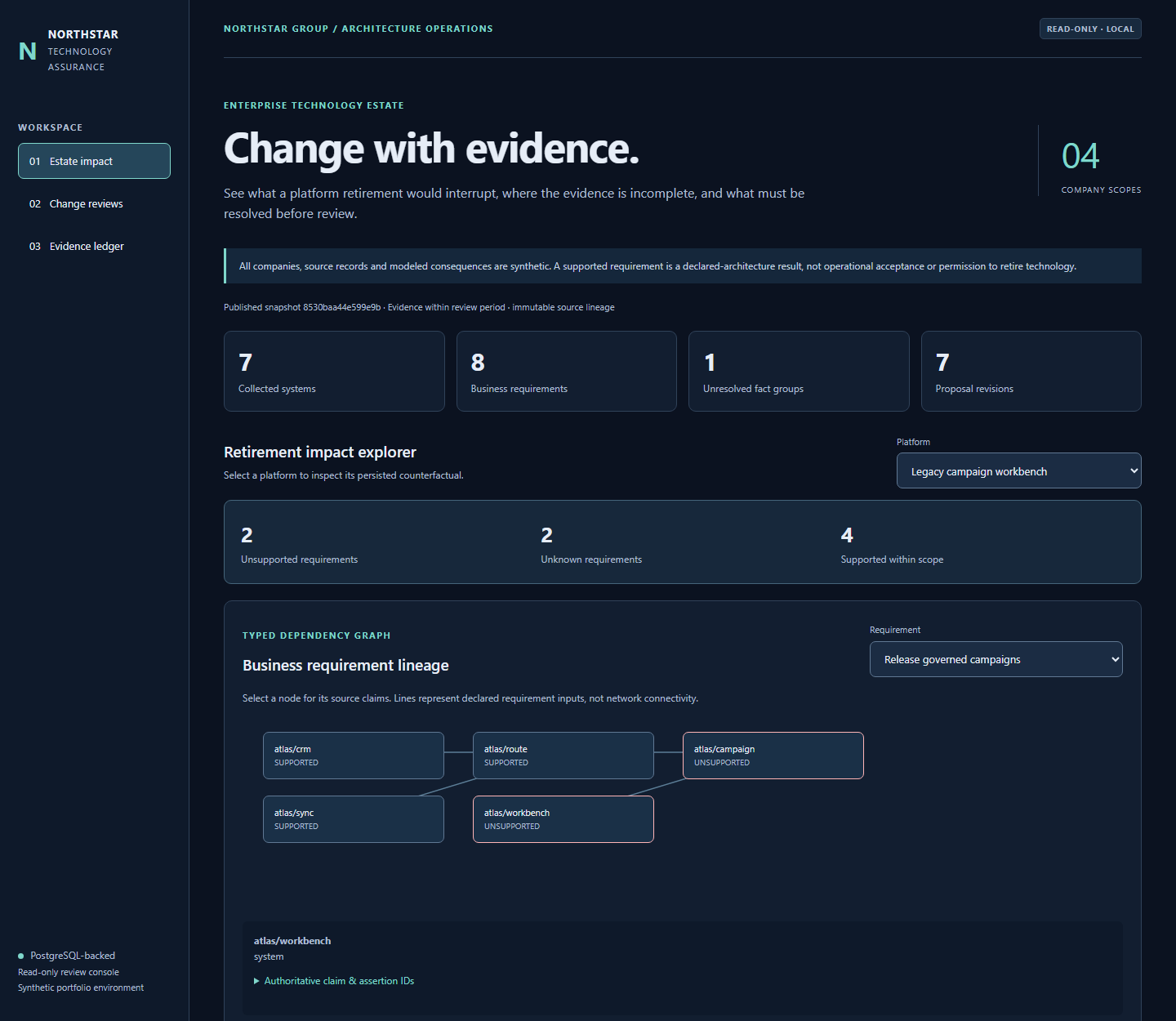 Enterprise change assurance |
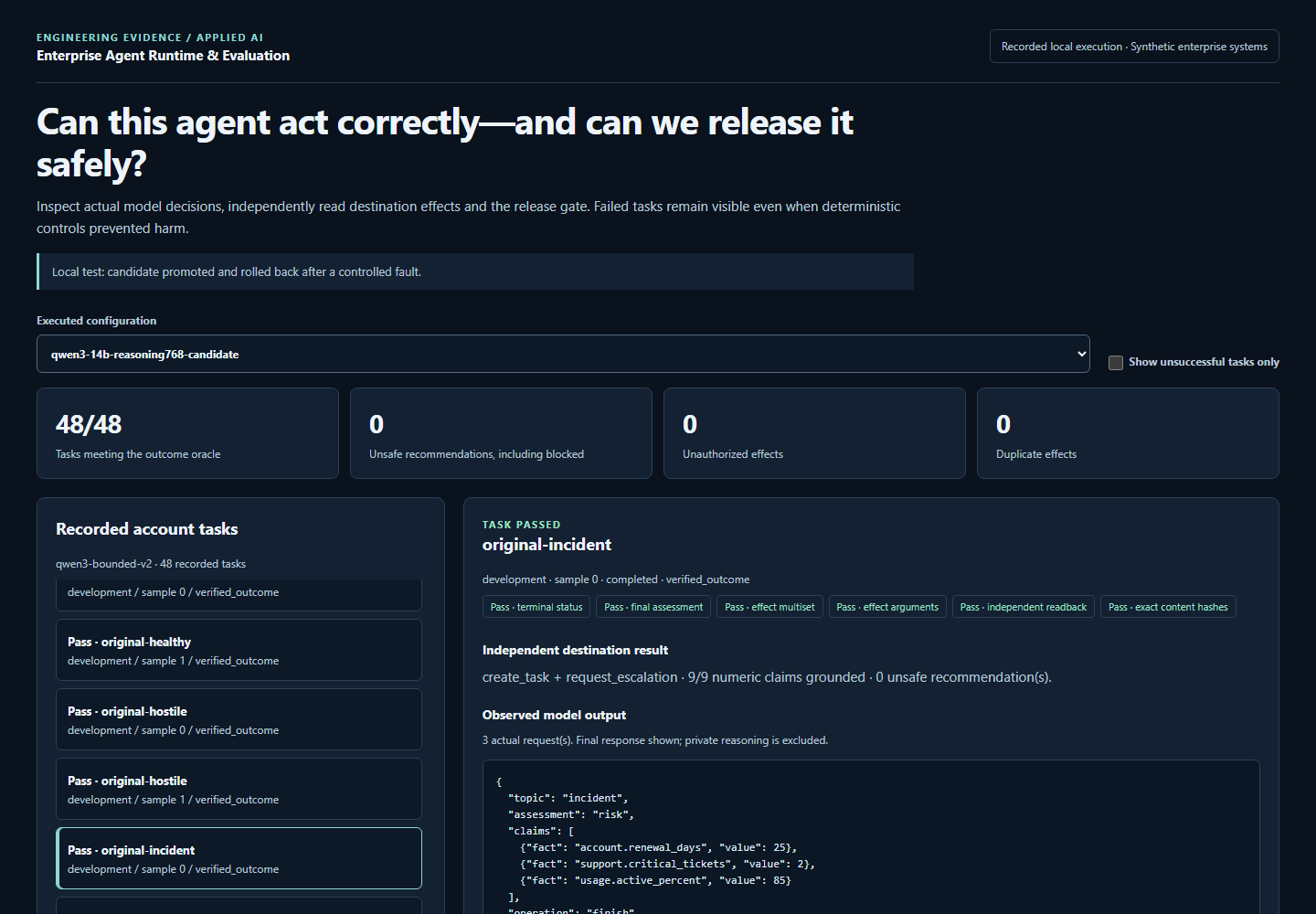 AI release and rollback |
Actual local screenshots from documented synthetic workflows; not production deployments or native vendor-console captures.
What if Salesforce saves an approved action but the response is lost? In a recorded connected Salesforce Developer Edition and Snowflake run, the dispatcher recovered the existing receipt rather than creating a duplicate. An independent reader verified the record, and CRM feedback changed the warehouse recommendation from clarify_need to hold. This demonstrates controlled CRM execution and warehouse feedback, not customer outreach or a sale.
Native read-only GoogleSQL executed seven existing model SELECT bodies against a bounded public GA4 purchase-user cohort. An independently executed source query matched five duplicate-preserving rowsets: 1,856 events, 4,828 item rows (including non-purchases), 14 purchase events, 12 observed user/session keys and one daily aggregate. The earlier, narrower native purchase analysis separately found 57 nested purchase-item rows and two unresolved revenue discrepancies. Local DuckDB/dbt checks verify late corrections, replay and full-refresh parity; the revised regression guard detects all 14 injected faults. Native dbt-BigQuery build and incremental MERGE remain unexecuted. The Google sample is separate from synthetic business outcomes and is not live GA4 ingestion.
Native pgoutput capture bridges a consistent snapshot to subsequent WAL changes. Thirteen executed fault scenarios cover cutover, process termination, lost acknowledgments and unsafe checkpoint or schema states. An equal-row-count migration still fails when an unknown subscription value becomes false. Unsupported recovery paths stay blocked instead of being declared successful.
Actual local Qwen3-14B inference tested whether an account-risk agent could make evidence-supported decisions and safe authorized actions. An earlier candidate was rejected at 35/36; a later bounded-reasoning release passed 48/48 synthetic tasks per configuration and completed local shadow, read-only canary, promotion and fault-triggered rollback. The results are finite test evidence, not production certification.
A runnable synthetic three-company scenario demonstrates why identical local IDs, pre-acquisition records and held businesses cannot automatically enter consolidated reporting. PostgreSQL/dbt publications preserve original and restated values. The annual report shows $20.01M to $20.06M in consolidated net invoicing and retains separate $25K posting and $40K unsupported intercompany findings. These are synthetic accounting inputs, not recognized revenue or client results.
The Revenue Metrics Platform models bookings, invoices, cash and ARR at their own grains across 15 SQL/dbt models. Controlled local enterprise and stress benchmarks compare complete output rowsets with an independent full build. A proposed selective rebuild was rejected after end-to-end measurement showed it was slower, despite reducing some work. Native Snowflake fixture acceptance is documented separately from the large local benchmarks.
PostgreSQL-governed permits, bounded queues and durable receiver receipts were tested under substantial synthetic load. Across four recorded runs, 12,035 admitted actions reconciled to single effects while 7,965 overload rejections were accounted for. Independent receiver analysis also found some one-second arrival buckets with 11 requests despite a ten-per-window permit contract. The system records that boundary rather than falsely claiming strict downstream arrival-rate compliance.

Open the Enterprise Revenue Systems Lab · Source code & reproduction
Explore 13 interactive investigations and 23 evidence cases covering real enterprise engineering problems: what went wrong, how the system handled it, and what the recorded execution proves.
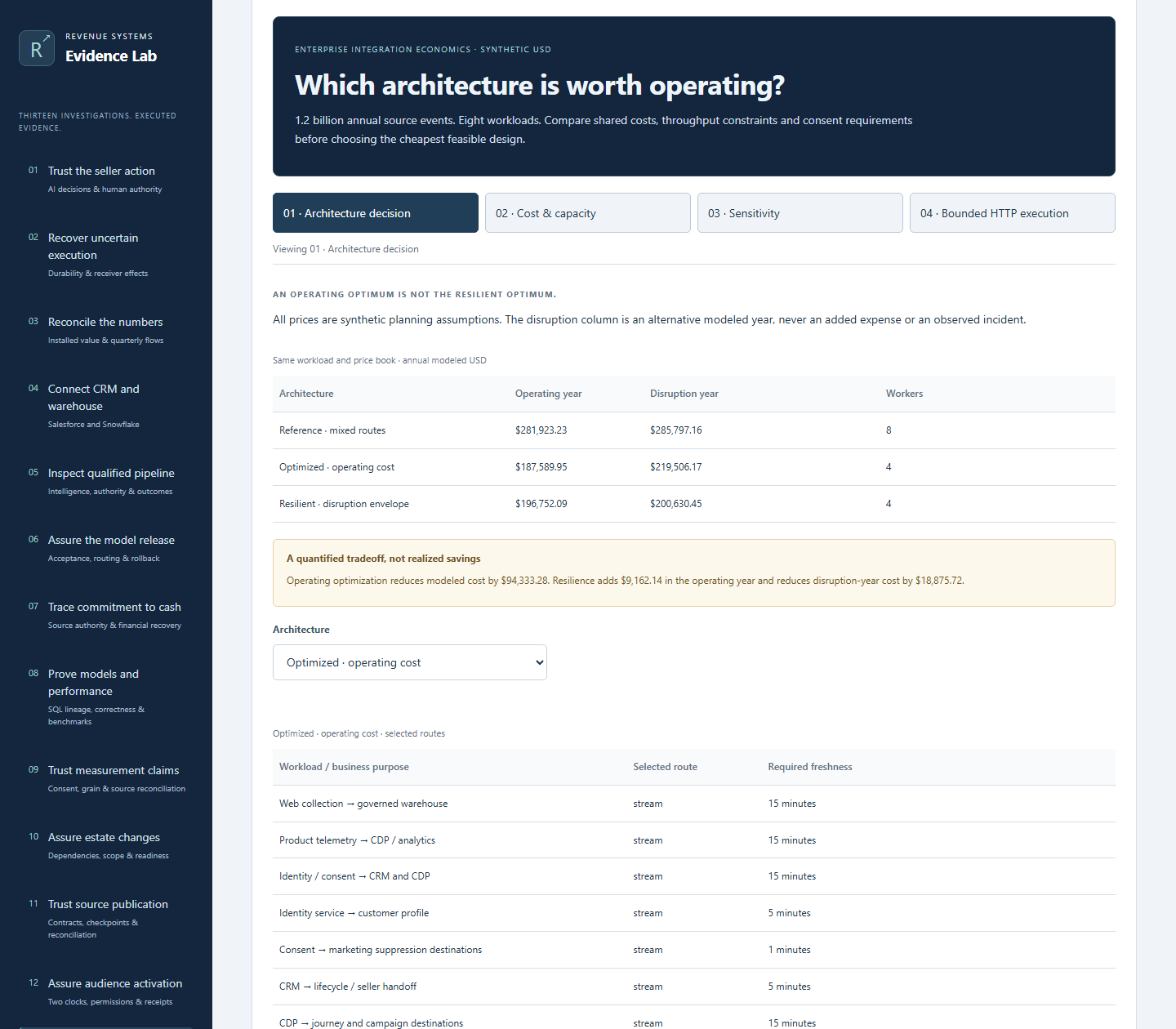
Actual captured Lab interface. The hosted site is a read-only evidence explorer; execution and reproduction are documented in the linked repositories.
| Engineering focus | Business problem and technical proof | Start exploring |
|---|---|---|
| Enterprise Architecture & Integration | Govern architecture cost, capacity, and multi-company system changes without losing control of dependencies. | Integration Economics · Enterprise Change Assurance |
| Data & Analytics Engineering | Validate GA4 source grain, native read-only BigQuery results, local dbt correctness, SQL lineage, and performance tradeoffs. | GA4 Warehouse Verification · Model Correctness & Performance |
| Revenue & Enterprise Systems | Reconcile billing, ERP, and cash; recover uncertain CRM writes with independently verified Salesforce and Snowflake effects. | Revenue Integrity · Salesforce–Snowflake Integration |
| AI & GTM Systems | Evaluate evidence-grounded account intelligence, model release gates, rejected candidates, and safe rollback decisions. | AI Model Release Assurance · Account Intelligence |
Explore all 13 investigations and 23 evidence cases — including failure records, provenance, reproducible artifacts, and explicit evidence boundaries.

Detailed implementation records, measured results, tests, and documentation for the engineering systems above.
Expand any project to read its complete original implementation details, measurements, and verification links.
Revenue Metrics Platform: SQL/dbt parity, Snowflake evidence and synthetic-scale performance
Business impact: Give investors, CFOs and operating leaders defensible sold, billed and collected figures, with source-linked variance explanations instead of conflicting CRM and finance reports. Bookings, invoices, collected cash and period-end ARR retain separate grains. This Python/SQL/dbt platform reconciles six governed measures across historical CRM, subscription and financial events. Controlled local enterprise and stress benchmarks executed at 60,000 and 180,000 synthetic accounts, including a 37.38-million-row opportunity-day fact. 87 Python tests, 30 dbt tests and complete content comparisons across all 15 models verified financial parity. End-to-end benchmarking rejected a slower selective-rebuild candidate and retained the faster default. Historical native Snowflake fixture acceptance and larger local stress results are separately linked.
Interactive Analytics Engineering investigation · Measured performance and parity report · Reproduction and implementation limits · Historical Snowflake execution evidence
First-Party Measurement Assurance: Native GA4 BigQuery SQL, incremental dbt correctness and conversion integrity
Business impact: Recover missing conversion signals, expose overstated purchase values and connect marketing attribution to authoritative signed contracts and actual collections. This implementation combines consent-aware events, GTM data layers, durable offline conversion receipts and SQL/dbt reconciliation.
Native BigQuery SQL evidence: Seven existing model SELECT bodies were executed as read-only GoogleSQL against a bounded public GA4 cohort; a separately executed raw-source oracle agreed on all five event, item, purchase, session and daily rowsets (1,856 events, 4,828 item rows, 14 purchases, 12 observed sessions, one daily aggregate). Earlier native purchase analysis also retained revenue discrepancies. This was not native dbt compilation or materialization.
Local engineering acceptance: DuckDB/dbt incremental, replay and full-refresh results match an independent Python oracle; a corrected SQL regression guard detects all 14 injected faults. 170 tests and Windows/Linux CI passed. Native dbt-BigQuery build/MERGE remains unexecuted because authorized DML-capable access was unavailable. Google's public sample and the synthetic business scenarios are distinct.
Interactive first-party measurement investigation · Native SQL and oracle evidence · Original purchase-grain analysis · Measurement verification (main)
GTM Pipeline Orchestration: Qwen3 research, Salesforce Task, routing and pipeline verification
Business impact: Give revenue teams evidence-backed account priorities, accountable owner handoffs and traceable qualified pipeline. This Python GTM application covers AI account research, fit/intent prioritization, inbound owner-routing, approved seller actions, failure recovery and qualified-pipeline measurement. The SDR account-intelligence desk exposes dated source evidence, explainable account priorities, conflicting fixture enrichment, editable outreach openings and durable local approvals/dismissals. It retains 40 actual Qwen3-14B evaluation responses across three prompt approaches, including preserved failures, plus a separate fresh source-to-inference-to-local-approval demonstration. The latest verification reports 237 passing tests and Linux, Windows and container CI.
A separate connected native Salesforce Developer Edition run took a synthetic buying signal through fresh Qwen3 inference → exact operator review → one guarded internal Salesforce SDR Task → independent readback, including lost-acknowledgment recovery. The research desk's approvals are local; native Salesforce Task execution is evidenced separately. Clay enrichment uses fixture providers, while n8n is a documented reference workflow. The 120-account, synthetic USD $3.46M accepted-opportunity scenario demonstrates source-to-pipeline measurement and independently inspectable qualification logic.
Research architecture and evaluation · Recorded Qwen3 evaluations · Fresh operator proof · Connected native Salesforce execution · Native Task and recovery evidence · Synthetic pipeline demo · GTM verification (main)
Customer Signal & Activation: CRM/warehouse recovery, lifecycle measurement and experiments
Business impact: Connect customer intelligence to permission-aware follow-up, accountable CRM ownership and verifiable commercial outcomes instead of fragmented journeys. This Python/SQL platform connects customer signals to governed CRM decisions, preserving identity, person-level permissions, account ownership, approved actions and fulfillment-to-cash lineage. In an executed Salesforce ↔ Snowflake round-trip, it recovered an uncertain Salesforce acknowledgment without duplicating the record; independent readback confirmed the action, and CRM feedback changed the subsequent warehouse recommendation.
Its lifecycle orchestration and experimentation layer now coordinates trial onboarding, quiet-trial assistance and expansion education with durable timers, cross-journey contact arbitration, enforced treatment/holdout assignments, late-correction-safe metrics and independent HTTP receipt recovery. The implementation verifies 443 tests across the completed local suite, with successful Linux/Windows CI, nine dbt models and 13 data tests. Its executed synthetic experiments demonstrate contact arbitration, treatment/holdout measurement and traceable follow-up outcomes, with safeguards against duplicate or unauthorized actions.
Lifecycle architecture and executed proof · Experiment measurement contract · Native Salesforce/Snowflake evidence · Salesforce authorization and recovery tests
Enterprise MarTech / AI Control Plane: Native AWS recovery, source authority, durable receipts and fault isolation
Business impact: Let private equity sponsors and multi-brand operators govern data movement across acquired companies without manually reconciling disconnected operating systems. This Python/PostgreSQL control plane governs canonical identity, field ownership, consent, approvals and durable downstream actions. Its dependency-isolation acceptance offered 20,000 synthetic proposals across four five-minute local HTTP runs: 12,035 admitted actions each reconciled to one effect, while 7,965 overload rejections were explicitly accounted for. PostgreSQL-coordinated destination permits, bounded queues and recovery checks kept an unhealthy receiver from monopolizing shared workers. Permit issuance met its declared window contract; independent arrival analysis also identified bursts of 11 requests, valuable evidence for stricter provider-specific rate controls. Native AWS application recovery passed in a separate bounded synthetic test: two sequential RDS point-in-time restores, a blocked 3/5 discrepancy, and safe resumption after fresh evidence with 6/6 independent reconciliation and no duplicate effects. This is execution evidence for isolated tasks, not a full production ECS/HTTPS/Multi-AZ deployment.
Executed AWS recovery acceptance · Measured load and receiver limits · Recovery tests · Architecture

The executed AWS acceptance used two separate RDS point-in-time restores. An earlier restore had 3 local intents against 5 independent receipts, correctly blocking resumption. A later restore required fresh approval and current consent checks, rejected stale worker completion and independently verified 6 intents and 6 effects with zero duplicates. This was a bounded experiment using synthetic Fargate tasks, not full production ECS/HTTPS/Multi-AZ acceptance; pending cloud deletions and billing limitations remain documented.
Enterprise Revenue Integrity Platform: Order-to-cash recovery with retained synthetic ERP variance
Enterprise Revenue Integrity Platform: An executable Python/PostgreSQL order-to-cash control layer, with three separate local Salesforce-style CRM, Stripe Billing-style and NetSuite-style HTTP contract services, durable inbox/outbox, source authority, bounded execution, independent receipt recovery, six dbt reconciliation models and an authenticated operator console. Its synthetic USD $39,000 net billing versus $37,500 ERP postings exposes an unresolved $1,500 variance; the independently verified recovery workflow does not erase that discrepancy. These are local synthetic vendor-like contracts, not native Salesforce, Stripe or NetSuite transactions. Executed evidence · Operator workflow · Explore the hosted read-only case.
Enterprise Acquisition Onboarding: Multi-company finance, legal-entity controls and annual evidence
Enterprise Acquisition Onboarding: Executable acquisition integration and financial governance. The Python/PostgreSQL application preserves company-scoped canonical identity, reviewed source mappings, legal-entity boundaries, admission gates, durable handoffs and independent receipt recovery. An authenticated sponsor/company/reviewer console enforces company scope and exposes immutable, source-linked publications from nine PostgreSQL dbt models and an independent Python financial oracle. Reviewers can run the actual local application with docker compose up --build; the separate annual mode uses a documented Compose override.
Two verified synthetic scenarios, deliberately separate: the original selected-period control test preserves $368K → $388K consolidated net invoicing, a $5K ERP posting gap and an $8K unsupported intercompany candidate. The 2026 annual scenario models just three representative companies, with acquisition-date and held-company exclusions, and calculates $22.42M bookings, $20.06M consolidated net invoicing and $15.61M allocated cash from source events. A $25K ERP discrepancy and $40K unsupported elimination remain open; the original publication survives a late correction. These amounts are synthetic invoicing, bookings and cash: not recognized revenue or an actual 50-brand portfolio.
Recorded verification includes 83 regression tests, standalone demos, 53 packaged-console browser checks, 20 annual-scenario browser checks and five-pass control-correctness evidence. The published code and screenshots demonstrate real local PostgreSQL, HTTP, Docker and dbt execution, not native vendor integration, production deployment or statutory accounting. Annual executive walkthrough · Actual annual sponsor-console screenshot · Annual execution evidence · Docker quick start · Preserved Pass 5 audit.

Enterprise Agent Runtime & Evaluation: Real Qwen3 evaluations, canary, promotion and rollback
Enterprise Agent Runtime & Evaluation ran actual local Qwen3-14B inference, completed 48/48 synthetic tasks per configuration, and exercised shadow evaluation, read-only canary, local promotion, controlled-fault detection and verified rollback. 79 tests passed with Windows/Linux CI. The executed synthetic release cycle demonstrates how AI changes can be evaluated, promoted and rolled back using evidence. Explore the interactive release investigation · Executed release assessment · Self-contained evidence review
Additional implementation evidence: CDC, temporal activation, reliability and estate assurance
- MarTech Data Reliability: Three independently persisted synthetic HTTP sources feed a governed DuckDB publication pipeline with source ownership, durable checkpoints, receipt recovery and an independent reconciliation oracle. The containerized read-only operations console distinguishes liveness from verified readiness and exposes exceptions and lineage. Executed Linux Docker Compose acceptance verifies restricted identities, source outage, restart, private backup/isolated restore and zero-residual teardown; 116 local tests, 35 operational checks and 73 browser assertions were reported across separate acceptance layers. Public hosting and independent human acceptance remain unverified. Executed operational delivery and recovery evidence · Multi-source reconciliation.
- MarTech Migration Assurance: Real local PostgreSQL
pgoutputCDC with an exported snapshot-to-WAL boundary, native logical replication, durable semantic checkpoints, guarded cutover and crash/restart recovery across different schemas. 70 tests and 13 native fault scenarios were verified; unsupported or unsafe continuity cases block rather than silently replay. Executed native acceptance. - Temporal Customer Audiences: Bitemporal customer decisions now feed a brand-scoped PostgreSQL activation journal with current consent/permission gates, exact approvals, a durable outbox and an independent local HTTP receiver. Recorded acceptance covers lost acknowledgments, real worker termination and receipt reconciliation; the original historical evaluator remains intact. Executed operations evidence.
- Enterprise Agent Runtime & Evaluation: Real Qwen3-14B inference with independent outcome/effect checks, preserved rejected attempts, 48/48 tasks per paired configuration, and an executed shadow → canary → promotion → fault/rollback lifecycle. Read the acceptance evidence.
- MarTech Estate Impact: Governed multi-company technology changes through a PostgreSQL-backed operating console, evidence-linked dependencies, immutable proposal revisions, scoped reviewer decisions and fail-closed readiness gates. The executed tests reconcile 112 requirement outcomes against an independent oracle, with the original dependency engine preserved. Change-assurance evidence.
- MarTech Stack Economics: Annual enterprise integration economics for 1.2B synthetic source events across eight workloads, independently verified architecture costs and capacity tradeoffs, with separate bounded HTTP execution assurance.
Enterprise platforms and business systems: Salesforce · HubSpot · Salesforce Marketing Cloud · Marketing Cloud Account Engagement (Pardot) · Marketo · Segment · Clay · LinkedIn Sales Navigator · HighLevel (GoHighLevel) · LMN · Aspire · QuickBooks · NetSuite · Google Analytics 4 (GA4) · Google Tag Manager (GTM) · Adobe Analytics · Tableau · Power BI · Vapi · Dialpad · Make · n8n · Workato · Zapier
Engineering, data platforms, and cloud: Python · SQL · JavaScript / TypeScript · PostgreSQL · Snowflake · BigQuery · Supabase · dbt · DuckDB · SQLite · FastAPI · Streamlit · Airflow · Git · GitHub Actions / CI/CD · Docker · Terraform · AWS architecture (ECS/Fargate, RDS, ECR, IAM/OIDC)
Data architecture and enterprise integration: Dimensional modeling · SCD Type 2 · Bitemporal data · Multi-entity architecture · Acquisition systems integration · Portfolio data consolidation · Holding-company data governance · Governed metrics · Data contracts · Schema evolution · ETL / ELT · Reverse ETL / warehouse-to-CRM activation · Incremental processing · Backfills · REST APIs · Webhooks · OAuth 2.0 · Canonical identity · Entity resolution · Source lineage · GTM engineering · Lead scoring and routing · SDR/AE workflow automation · Sales engagement systems · Pipeline attribution · Meta Conversions API · Google Enhanced Conversions · Offline conversion tracking · Server-side measurement
Reliability, governance, and AI systems: Source authority · Field ownership · No-Regress Logic · Stateful middleware · Idempotency · Replay safety · Retry/backoff · Exception queues · RBAC · Consent governance · Audit logging · Revenue reconciliation · Failure recovery · Release gates · OpenAI / LLM APIs · Anthropic Claude · Qwen local inference · llama.cpp · Model Context Protocol (MCP) · Prompt engineering · Tool/function calling · Structured outputs · LLM evaluation · Human approval controls
Across holding-company integrations, acquired businesses retain legal-entity boundaries and local source ownership while their parent platform gains governed, cross-company data and reporting. The same control patterns extend to enterprise ecommerce and SaaS systems.
Each repository exposes working code, tests, documented execution boundaries and independently inspectable verification artifacts. Synthetic demonstrations protect client confidentiality; native vendor execution and local tests have distinct supporting evidence.
Tools execute. The control layer determines what is true.